Review of “The Digital Dimension” by Andrew

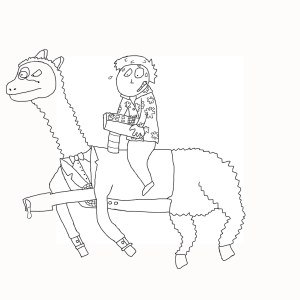
Some of you may remember my first post on the writing blog, which included a review of Bob and the Cyber-Llama by my young friend, Andrew Empedocles. For the unenlightened, the review went as follows:

Dear Joseph,

                 Your Bob and the cyber-llama book was amazing!!!!! Your book was the best book I have ever read!!!!!  Every part is so good, that I don’t even know what my favorite part was!!!!!  I stayed up all night reading it because it was so good.  Please make another book and send it to me.  I’m even making some books that I am going to send to you.

                                                                                     From,

                Andrew

(P.S. I wish that I could put llama emoji’s all over the page, but I don’t know how)

Mr. Empedocles kept his word and cooked up a literary work of grand proportions known as The Digital Dimension.

It is a work of suspense and mystery featuring three adventurers: Trevor, Aaron, and Greyson. The three are real-life friends of the author (I’m sure that, since the book was written, the three of them have graduated from Harvard or created a vaccine to eradicate mesothelioma or something.) Beginning with a prologue, we find Greyson lying in a hospital bed with a splitting head wound.

As he slowly regains consciousness, Greyson is greeted by Trevor and Aaron, who stumble into the hospital wrapped in bandages and covered in bruises and scrapes. Trevor then spins a tale of intrigue and tension and tells Greyson that, after Greyson was knocked out by a well-placed baseball, Trevor and Aaron rented a video game from a suspicious game store. We’ve all rented video games right after hospitalizing our friends, right?

Trevor reveals that, after injuring their friend, he and Aaron were sucked into a strange video game world full of hostile, pixelated bears, thick forests of mystery, and a creature “part monkey part rhinocerous part bear and more things of animals that we couldn’t even understand what it was.”

The Digital Dimension also features a parallel story about a man sent of a variety of daring missions by a mysterious employer. He travels into the digital dimension and explores a dark, Egyptian museum full of death traps. How this fellow’s story ties into the overall tale is a secret I don’t dare reveal.

With the threats of pixelated monkey-rhino creatures, reanimated mummies, and alien invasions looming, Trevor and Aaron must escape the digital dimension before their real world is consumed by chaos. If you’re a fan of adventure books, high-brow literature, or sentences like “the beast punched him to Jupiter”, give The Digital Dimension a read.

But I really couldn’t put it any better than the critic featured on the back of the book:

“A MASTERPIECE! Andrew Empedocles does it again, with a riveting story that keeps you on the edge of your seat right up to the very end! It has all the wit and thrill of Michael Crichton, with the chilling futuristic vision of Arthur C. Clark, rolled together into a brilliant story that will hold you in suspense…and have you laughing milk out your nose. The Digital Dimension is a definite must read.”

-Andrew’s dad
The Charity Month was a Huge Success!

Sound the trumpets! Kill the fattened mongoose!

The charity month was a huge success!

For those of you who haven’t been keeping up with the blog, I will be donating all of the profits I earned during the month of August to CURE Childhood Cancer and Canines for Disabled Kids. I wasn’t sure how much I’d earn, but thanks to the generousity of our readers, Curt Fulster and I raised a bundle!

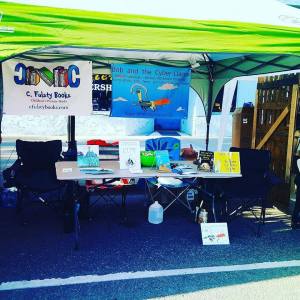
The biggest event of the month was the Western Welcome Week festival in downtown Littleton. We manned a booth all day, gained some new readers, and raised quite a bit for the charities. We even got a couple of generous cash donations from some older gents.

Special thanks to my mom and dad and Matt, Sarah, and Alethea Bubke for helping out (Matt’s improvised song and dance made a lot of festival-goers curious about our booth)!

I’m honored  that I was able to help raise money to fight childhood cancer and help disabled kids. The charity  month was a fantastic experience and something I may revisit in the future…

Bob and the Cyber-Llama at Western Welcome Week

I have yet another piece of poodle-roastingtly exciting news: I’m going to have a booth at the Western Welcome Week festival in downtown Littleton on August 19!

The Western Welcome Week festival has taken place once a year for almost a hundred years. It’s a huge community celebration in downtown Littleton, Colorado. Events take place from 8am to 5pm on most days from Friday, August 11 through Sunday, August 20.

The real action takes place on Saturday, the 19th. There’s a huge parade, a bunch of vendors selling books, food, entertainment, and other goodies, an obstacle course, gryphon rides, orca-eating contests, and giant robot battles. Or at least, some of those things.

I’ll be sharing a booth with Curt Fulster of C. Fulsty Books, who’s also donating his August profits to charity.

As I mentioned in my last post, I’ll be donating all of the money I make in August to CURE Childhood Cancer and Canines for Disabled Kids. This includes all of my Western Welcome Week sales, so be sure to stop by and support a good cause.

Stay tuned for details on my booth location!

Charity Donation Month

A few weeks ago, I was sitting in my underwear eating Doritos and watching The Smurfs when I thought, “You know, maybe I should get off my butt and do something that makes a difference.”

So I put on pants.

And then I decided to help out some charities. Throughout August, I’ll be partnering with Curt Fulster of C. Fulsty Books and donating all of my profits to CURE Childhood Cancer and Canines for Disabled kids!

CURE Childhood Cancer is committed to seeing childhood cancer cured during our lifetime. They’ve raised over $32 million over the last ten years to fund research and support kids and their families. CURE provides services to people in a variety of situations; they offer resources to families of recently-diagnosed kids, help out with meals, and even provide after-treatment services for families with kids done with treatment.

I didn’t choose to donate to CURE by throwing a dart at a spinning wheel-o-charities. I’ve been affected by childhood cancer twice. In 2000, my baby cousin, Parker Caldara, was diagnosed with brain cancer. She died shortly thereafter. And a few years ago, my friend Cade Humphreys  got cancer, too. He’s finished his treatments and is doing well (his screenings have all been excellent – no sign of the cancer returning!)

The other charity I’ll be donating to is Canines for Disabled Kids, which provides service dogs for children with disabilities. When it was founded in 1998, very few charities were willing to provide such dogs for disabled kids, (service dogs are pretty expensive.) By providing scholarships to these kids and their families, CDK was able to make service dogs available to a lot more children and reduce the time it takes for kids to get one.

CDK also emphasizes educating people about the importance of service dogs and offers resources for families interested in such a dog.

Keep an eye on the website for future posts about the charity month and please use the links above to visit the CURE and CDK websites. I’m proud to be able to help out these organizations throughout all of August.

And I’ll be wearing pants the entire time.

Review of “My Buddy Knows…Letters!” by Keith Wheeler

Living through the ups and downs of life, I always try to view things from other people’s perspectives. And while performing this psychological practice, I always come to one inescapable conclusion: it must be really weird to be four years old.

Think about it. Four-year-olds can walk and run, but their legs are still a little chubby and infant-like. They usually speak like grown human beings, but sometimes end up sounding like a drunk Cookie Monster on helium. And, though they’re new to life, they suddenly have expectations thrust upon them.

When you’re four or five years old, you have three jobs:

  1. Learn your letters
  2. Learn your numbers
  3. Don’t poop your pants

Assuming you find it within yourself to count to ten and become a true deacon of the diapers, all that’s left is to learn your alphabet. Master that and you can lord it over all the other five-year-olds forever.

Keith Wheeler’s “My Buddy Knows…Letters!” is a fantastic way to teach kids the alphabet. The book makes letters fun while still pounding that sweet, sweet learning into kids’ heads like a jackhammer of knowledge.

It starts with a simple phrase: “This is my buddy, Josh! Josh knows a lot about…letters!” Josh looks like a nice guy, even though he could really use some self-tanning lotion and maybe a fashion consultant. Regardless, he’s a welcoming figure that kids will gravitate toward.

Readers are then shown a picture of an object and, on the next page, told which letter it begins with (“My buddy knows that apple starts with A”, “My buddy knows that ball starts with B”, “My buddy knows that colonoscopy starts with C”, etc.)

But unlike other alphabet books, this one has a unique twist: it shows kids a picture of the object, and then tells them which letter the word starts with. A toddler reading this book with their parents will think “oh, that’s an apple.” just before the book tells them “Apple starts with A.”

At that moment, the wires in that kids’ head will connect and the electricity will start flowing. Pretend there’s a motionless hamster wheel in the middle of your child’s brain. Reading this book is like putting a steroid-infused hamster in the middle of that wheel and letting that rodent fly.

“My Buddy Knows…Letters!” by Keith Wheeler will alleviate some of the enormous stress your four year old endures between episodes of “Mr. Rogers Neighborhood” by breaking down letters in a way they can wrap their heads around. Keep an eye out for “My Buddy Knows…Numbers!”, too. I expect it to revolutionize my world in a similar way.

Bob and the Pop-Up Book of Destiny Now Available

Kill the fattened calf! Sound the horns of celebration! Run into the streets, put on your finest top hat, coat your naked body in dijon mustard, and sing hallelujah!

Bob and the Pop-Up Book of Destiny is finally available on Amazon Createspace, Kindle, and Lulu!

In this, their second adventure, Bob Halibut and his cybernetic llama butler, Jeeves, travel to Mexico, where they use Hamadi’s map to explore an ancient Aztec ruin. Deep in the dark, stanky temple, they discover the Pop-Up Book of Destiny, an artifact of unimaginable power.

And after they encounter a vengeful conquistador, Bob and Jeeves battle long-dead forces to save Mexico City from destruction and despotic rule.

But the story is only part of the fun this time: each chapter now includes a picture of one of the characters or scenarios described in the book.

I’ve also added illustrations to the original Bob and the Cyber-Llama. You’ll have fortnights of fun gazing in awe at my glorious artistry, your personal hygiene slowly deteriorating as you fail to tear yourself away from its breathtaking beauty.

Like Bob and the Cyber-Llama, Bob and the Pop-Up Book of Destiny is a great read for kids, adults, and fifth-dimensional koalas alike. Buy it now or regret it for the rest of your days.

Review of “Animiximals” by Crystal Wenger

Before you read this post, I want you to think back. Way back, to your childhood, a time somewhere in-between the day you discovered hair underneath your armpits and that time you left the womb. A time when, if you were like me, you always looked forward to that special time of night when you would sit down with your mom or dad and hear them read you a story.

Most of the books I remember featured simple stories that were easy for kids to digest. I recall books like Corduroy, The Very Hungry Caterpillar, and its oft-criticized sequel, The Diabetic, Morbidly-Obese Caterpillar.

But do you remember those…other books? The ones that didn’t have much of a story and instead just featured a long list of strange, whimsical creatures? I remember spending hours just staring at the pictures in books like There’s a Wocket in my Pocket and One Fish, Two Fish, Red Fish, Blue Fish and feeling a different set of emotions hit me each time I flipped to a new page like a thousand base-jumping hamsters landing gently on my skull.

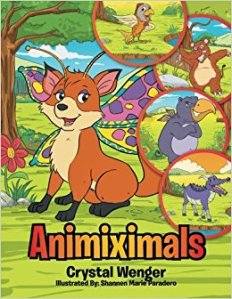
Animiximals is such a book of goofy creatures, and I’d recommend it to anyone looking to not just entertain, but to inspire their children. This isn’t just an imaginative book; there are plenty of those. It’s a book that sparks a child’s imagination.

Animiximals, written by Crystal Wenger, features a plethora of bizarre-looking creatures, each one a combination of two or more animals. You’ll meet creatures like a Dopher (a dog/gopher) a batsquito (a bat/mosquito), a butterfox (a bufferfly/fox), and a fishkin (a fish/chicken), which I eat my fill of whenever I go to Arby’s.

Every one of the images in this book stamps itself onto your mind. When I read through Animiximals, I immediately thought about what I would have done with this book as a kid. And that would have been to grab some tracing paper and recreate my favorite creatures so I could hang them on my wall.

The art has a lot of subtle touches, too. For example, each miximal is pictured next to a tree, bush, or other plant, which gives the reader a sense of its size (the zoose, for example, could easily destroy Tokyo in an afternoon.)

But the book isn’t just pictures. Each creature is described in sing-song-y rhyme. The rhyming language will grab and hold onto a kid’s attention like a starving chihuahua onto a chicken wing. But the best part about these descriptions is that they ignite childrens’ imaginations and cause them to look beyond the illustrations. They’ll picture the animal’s personality, voice, and mannerisms in their heads.

For example, the squig “doesn’t sound at all like a squirrel or a pig. It does, however, moo like a cow, bleat like a goat and makes these awful disgusting sounds from its throat.” Any kid who hears that sentence will immediately picture a squirrel-pig creature walking around a pasture, mooing.

My favorite part of Animiximals was actually its length. This book doesn’t just show you a handful of silly creatures and call it a day. There are twenty-eight of these things lurking within the book’s pages. It’s a nice, long read for a child and keeps the nutty critters keep coming.

If you have a kid who’s outgrown Go, Dog, Go, but is a little young for Bob and the Cyber-Llama or War and Peace, check out Animiximals. This book is an imagination-builder, a book that’ll keep your kid in that fun, make-believe mindset long after you’re finished reading.

And now that I’m done with this review, I need to stop by Hobby Lobby. I’ve got to pick up some tracing paper…

Cover Design: Part 2

In a post about two weeks ago, I described the complex, spiritual, mind-blowing, existential process of designing the cover for Bob and the Pop-Up Book of Destiny. I explained how I first take about an hour out of my busy schedule of writing “Andy Griffith Show” fanfiction to draw the initial cover in pencil:

After this, I scan the picture into the computer and trace the pencil lines like so:

Then comes the color. Over the past year or so, I’ve developed a pretty efficient process for coloring pictures. I use the magic wand on the black outline layer to select enclosed areas. I then use the modify tool to expand the selected area and fill it with color using the fill tool. I do have to zoom in and do a little additional coloring, as the magic wand tool isn’t perfect, but it’s a lot more efficient than using the brush to color an entire area.

At this point, I don’t need to use the original image anymore; the whole thing is a recreation of the original pencil drawing.

After this, I do the shading. Shading is like the crunchy exterior of a Klondike bar. It doesn’t seem flashy at first, but makes the whole experience much, much more enjoyable. Shading mimics the light source hitting the characters, which makes the image much more realistic (as realistic as a cartoon llama can be, anyway.)

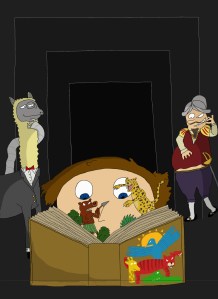
I take a darker version of an object’s color and use it to color the side of the object opposite the light source. For this cover, the characters are in a dark temple with light streaming from the pop-up book. I think the shading turned out pretty well:

The final step is to form a text box with the book’s title and add a mask to the layer containing the color and shading of Jeeves’ body in order to make him look furry. To do this, I link the color layers of Jeeves’ body and add a new one containing a giant patch of fur.

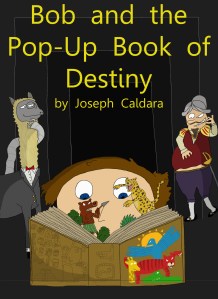
Then, I turn down the opacity of the fur layer to make it see-through. The final result looks something like this:

And voila! A cover that would make Michelangelo pee his pants with envy! Now that the front cover is done, I just need to work on the rear cover and the spine (which take much less time) and upload the book to Amazon. And then I just wait for my Pulitzer.

Adverbs: Falsest of Friends

Joining a writing or editing group can be an incredible experience. If you surround yourself with the right group of people, you gain invaluable feedback and improve your pieces of writing in a way you just can’t accomplish your own. It’s a productive, fulfilling experience.

If you surround yourself with the right group of people.

Eventually, you’ll find yourself in a writing group full of people terrified of offering the slightest criticism who assume that if they suggest even minor edits to your writing, you’ll start bawling like the precious, little lilac you are and spend the rest of your life locked in your basement wearing a stained wife-beater, shoving pistachio ice cream in your cakehole, and watching Smurfs reruns while blubbering “Why, oh why, did she not approve of the way I use semicolons?!”

The best piece of advice I’ve ever received from a writing group is this: adverbs are not your friends.

For those who don’t remember third grade English (or School House Rock), adverbs are words that can be used to describe other parts of speech. They’re not like adjectives, which can only be used to describe nouns (words like large, stinky, boisterous, and sticky.) Adverbs can be used to describe adjectives and verbs as well (words like slowly, very, deftly, or suddenly are adverbs.)

If you write adventure fiction, you’ll find yourself describing a lot of vibrant combat scenes and daring escapes. While writing such a scene, the temptation to use adverbs eats away at your undercarriage like a starving, hyperactive poodle.

I find myself using phrases like “he ducked under the table quickly” or “deftly, he drew his pistol.” The problem is that all those adverbs make the scene move pretty slowly. Which is not what you want in an action scene.

The adverbs also keep me from using more creative language. Instead of “he ducked under the table quickly,” I can say “he darted under the table.” Instead of “deftly, he drew his pistol,” I can say “he whipped out his pistol.”

Adverbs are the disgusting, garbage-scented cretins of the grammar world.  They should be shunned, shot, dragged through the streets, and hung up in town square as an example to other figures of speech.

Now, if you’ll excuse me, I need to go and cry into a pillow. Agnes from my new writing group suggested I stop using serial commas.

Cover Design

As the rapturous day of Bob and the Pop-Up Book of Destiny‘s glorious release draws ever-closer, I thought I’d give you some insight into one of the more…artistic sides of my writing process: cover design.

Until the release of the next book, I’ll be giving you a step-by-step tour of the cover design process. You’ll get to see the cover as it develops; and your brain will swell with joy as the images dance before your eyes like a thousand tiny elves. Who are hyped up on caffeine.

I’ve always enjoyed drawing cartoons and comics (check out my comic series here), and have been transferring my drawings to the digital world over the past few years. Now I use Photoshop, but believe it or not, I used to rely on Microsoft Paint to produce digital art. Both the Classystrugeon logo and the image of Jeeves on the Bob and the Cyber-Llama cover were done in Paint.

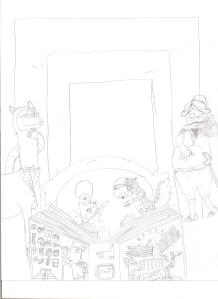
After experimenting with a few different techniques, I’ve finally nailed down a process. First, I draw the image on a white piece of paper and scan it into the computer. So the first version of Pop-Up Book of Destiny‘s cover looked like this:

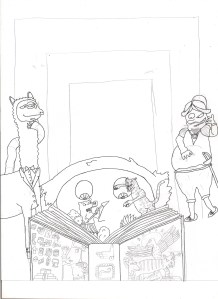
After the image is scanned, I use the brush tool to trace most of the pencil lines. Not only does this give everything the standard black outline seen in most cartoons and comics, it also allows me to enclose certain areas, which makes coloring much easier.

I also use the selection and movement tools during this step to resize or move certain parts of the image. For example, in the image above, I thought Jeeves’ neck looked a little too short. I moved it straight up and used the Photoshop brush to draw the area in-between.

There are two more steps to designing the cover: basic coloring and shading/detail. I’ll be sure to let you in on the process as the cover comes along!